AI Can Polish the Borrower Email. It Can’t Approve the Loan.
Your borrower sends a document at 4:45 p.m. You’re between calls, the underwriter is still reviewing the file, and you want to send a clear update before the day ends. An AI writing tool can make a rough note sound polished in seconds. It can also quietly turn “we’re still waiting” into “everything looks good.”
That difference matters. Borrowers may read a confident sentence as a decision, a condition, or a promise about timing. The safer use of AI in a mortgage office is narrower: let it help with wording, while the loan professional remains responsible for the facts.
The useful line: edit the message, don’t create the facts
Generative AI is good at producing fluent language. Fluency isn’t verification. A sentence can sound measured and still include an unsupported status, an invented next step, or a date nobody confirmed.
That risk is especially easy to miss in mortgage communication because small wording changes carry weight. “The lender has your file” is different from “the lender has completed its review.” “We’ve requested the updated paystub” is different from “once we receive it, you’ll be clear to close.” The second version in each pair implies more than the first.
Use an approved tool, if your company permits one, to shorten, soften, or clarify language you have already checked. Don’t ask it to infer the loan status, predict an underwriting decision, explain a condition it hasn’t seen, or tell the borrower what will happen next.
This distinction is consistent with broader guidance, though the sources apply in different ways. NIST’s Generative AI Profile is voluntary cross-sector risk guidance, not a mortgage rule. Fannie Mae’s October 2026 AI governance letter is directed to its Seller/Servicers and does not create a blanket broker requirement. Both are useful reminders to define oversight and responsibility rather than treating a polished output as self-validating.
A quick check before you send
Before an AI-assisted message leaves your outbox, check three things: status, source, and scope.
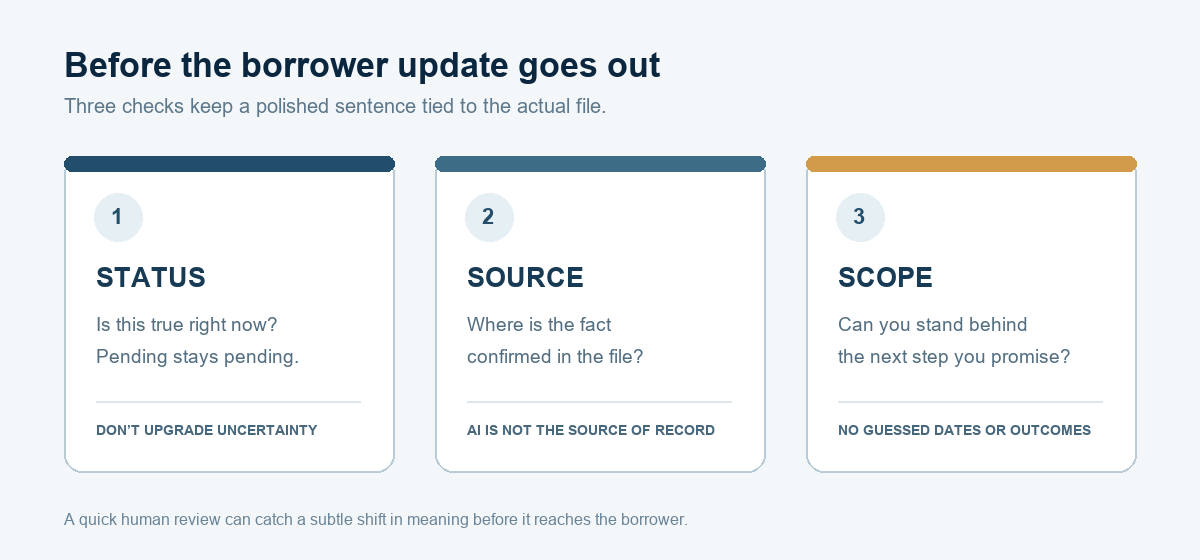
Status: Does the email say only what is true right now? If the file is pending review, keep it pending. Don’t let “in progress” become “approved” simply because a more reassuring sentence reads better.
Source: Can you point to the file, lender communication, or verified task that supports each statement? If not, remove it or confirm it with the appropriate person first. AI is not a source of record.
Scope: Does the message stay within what you can responsibly tell the borrower? A processor may be able to confirm that a document was uploaded; that does not necessarily mean the document has been accepted or that a condition is cleared.
One practical method is to draft the facts yourself in plain language, then ask the tool only to improve readability. For example: “We received the October paystub and added it to your file. The lender has not yet confirmed whether it satisfies the outstanding request. I’ll update you when we receive a response.” The tool can make that easier to read without changing the underlying meaning.
Protect borrower information, too
Before pasting anything into an AI service, check your company’s approved-tool and data-handling policies. A public tool may not be an authorized place for a borrower’s name, account details, tax documents, income, credit information, or other identifying data. Removing the name alone may not be enough if the rest of the prompt still identifies the person or transaction.
When you can, use a minimal, de-identified prompt focused on the writing task: “Make this neutral status update easier to understand. Do not add facts, dates, promises, or next steps.” Then compare the result with your original. If the tool is approved for protected information, follow the organization’s specific controls; don’t assume all products have the same settings or data protections.
The CFPB’s research on consumer-finance chatbots describes the limits of automated responses for complex or individualized issues. It is not an evaluation of every generative AI writing assistant, but the operational lesson carries over: when a borrower’s question needs file-specific judgment, a person who can verify the file should handle the answer.
Keep a human handoff in the workflow
AI can help with a routine update. It shouldn’t become the final reviewer of a condition explanation, a sensitive borrower concern, or a message about a material change in the transaction. Those need a human who can check the loan record, lender direction, and the team’s responsibilities.
If several people touch the file, make the handoff visible. Note what was received, where it was saved, what remains unconfirmed, who owns the next follow-up, and when the borrower should hear back. A clear file note is more dependable than asking a language model to reconstruct context from a thread or scattered documents.
The same principle applies to your broader workflow. A well-configured loan platform can give the team a clearer place to track documents and responsibilities. ARIVE is one option, not a requirement; EPC offers assisted setup, training, and workflow support for brokers who want help configuring it around their operation. The software doesn’t replace the human review, but consistent use can make that review easier to perform.
A short borrower-message pattern
For a straightforward status update, build the message from verified pieces:
- What happened: “We received the updated bank statement.”
- What it means now: “It’s been added to the file; review is still pending.”
- What happens next: “I’ll follow up with you when the lender confirms whether anything else is needed.”
Those lines are intentionally modest. If the lender has already confirmed something different, use the confirmed information. If you don’t know when an answer will arrive, don’t invent a deadline to make the email sound complete. A specific next contact point you can honor is more useful than a turnaround estimate you can’t control.
AI can make a message warmer or easier to scan, but the loan professional still owns its accuracy. When the tool changes the meaning, the edit is no longer just an edit.
Want a second set of eyes on your communication workflow?
If your team is deciding where AI fits—and where a human review should remain—book a short EPC workflow consultation.
Educational note: This article is general information for mortgage professionals, not legal, compliance or underwriting advice. Guidelines change; confirm current requirements with the agency and your lender.
Sources
NIST AI Risk Management Framework: Generative AI Profile