Two Score Models on the FHA Report. Which Number Is the MDCS?
An FHA file comes back from the credit vendor with two score models on the report: Classic FICO for both borrowers and VantageScore 4.0 for both borrowers. The LO wants to know one thing before structuring the loan: which number is the FHA minimum decision credit score, and does it still clear 580?
Starting with case numbers assigned on or after January 1, 2027, FHA answers that question with a new method. The old "middle of three, lower of two" habit still matters, but it is now only the first step. A broker team that picks the wrong number can misjudge maximum financing, set the wrong borrower expectations, or send a case binder to the lender with a credit report that does not match what was run through TOTAL.
FHA minimum decision credit score: what changed
HUD's Mortgagee Letter 2026-11, dated October 8, 2026, updates FHA's Minimum Decision Credit Score (MDCS) methodology "to facilitate the adoption of alternative credit score models." It adds FICO 10T and VantageScore 4.0 alongside Classic FICO. The provisions are effective for case numbers assigned on or after January 1, 2027.
Two things did not change. The letter states that "FHA will continue to require a tri-merge credit report, and the existing minimum credit score thresholds remain unchanged regardless of Credit Score Model Type." The 580 line for maximum financing and the 500 floor still apply; what changed is how you arrive at the score you compare against them.
If you read our earlier post, The Credit Score Changed. Did the Borrower Change, or the Model?, this is the FHA piece of that same shift. The difference now is a published FHA method with a firm case-number date.
The new three-step method
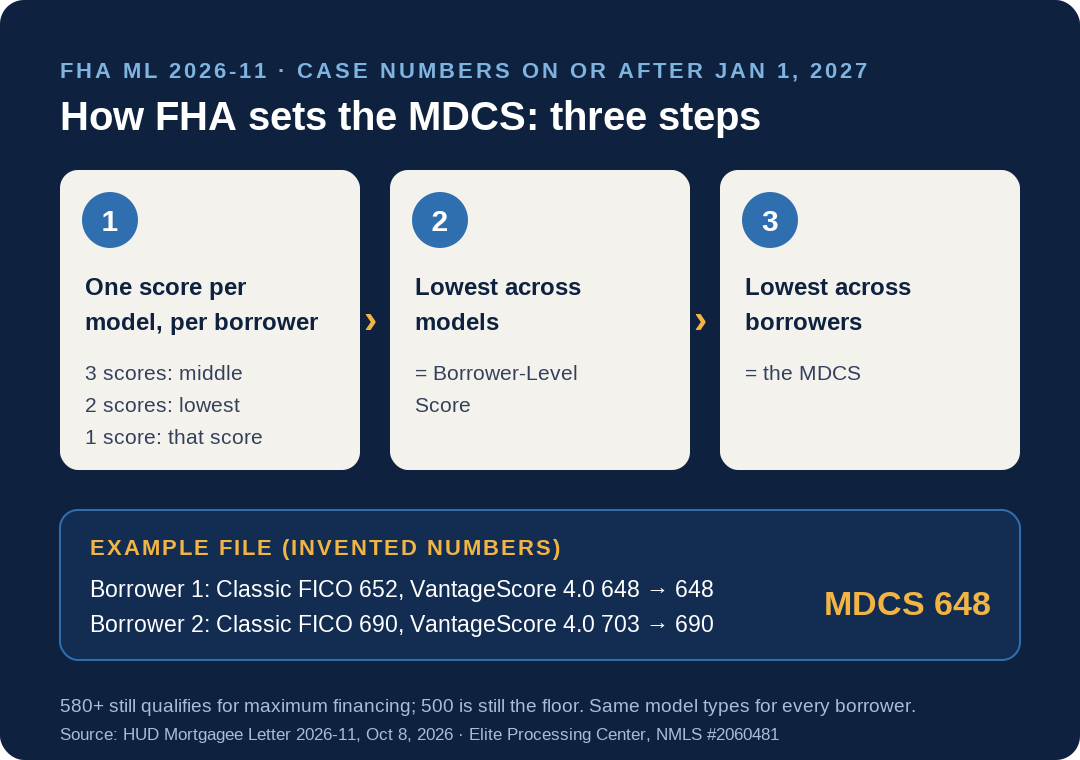
Under the revised Handbook 4000.1 language in the letter, the MDCS is built in three layers instead of one.
- Pick one score per model, per borrower. Within each Credit Score Model Type submitted: if three differing scores are reported, use the middle score; if two differing scores are reported, use the lowest; if only one is reported, use that score.
- Take the lowest across models. The Borrower-Level Score is the lowest of the scores selected from each model type submitted. If only one model type is submitted, the score from step one is the Borrower-Level Score.
- Take the lowest across borrowers. The MDCS is the lowest Borrower-Level Score among all borrowers on the transaction.
The letter also covers borrowers without scores. Where one or more borrowers have non-traditional or insufficient credit, the MDCS is the lowest Borrower-Level Score among the borrowers who do have scores. The letter keeps the requirement that borrowers with non-traditional or insufficient credit be manually underwritten, and a transaction with an MDCS below 500 is not eligible for FHA-insured financing.
Example file
Two co-borrowers, invented numbers. Borrower one shows Classic FICO scores of 640, 652 and 661, and two VantageScore 4.0 scores of 648 and 655. Borrower two shows Classic FICO scores of 684, 690 and 701, and one VantageScore 4.0 score of 703.
| Step | Borrower one | Borrower two |
|---|---|---|
| Classic FICO (middle of three) | 652 | 690 |
| VantageScore 4.0 (lowest of two, or the only score) | 648 | 703 |
| Borrower-Level Score (lowest across models) | 648 | 690 |
The MDCS for this file is 648, the lower of the two Borrower-Level Scores. If the lender had submitted Classic FICO alone, the MDCS would have been 652. Adding a model can only hold the score steady or lower it under this method, so the choice of models is a decision, not a formality.
What the file needs
The letter puts two documentation rules around model choice. First, "the Mortgagee may submit one or more Credit Score Model Type(s), provided the same model type(s) are used for all Borrowers." HUD's own example: the lender may not submit FICO 10T for the primary borrower and VantageScore 4.0 for the co-borrower.
Second, "the credit report retained in the case binder must include all Credit Score Model Type(s) submitted in the final TOTAL submission." The report may carry extra models that were not submitted, but it cannot be missing one that was.
For a broker file, that means the lender decides which models it submits to TOTAL, and the broker team needs to know that decision before quoting maximum financing on a borderline score. Ask your AE whether the lender will run Classic FICO only, add an alternative model, or let it vary by file once case numbers dated 2027 start coming through.
Where files go wrong
- Using the old median out of habit. On a 2027 case number with two models submitted, the middle Classic FICO score is no longer automatically the decision score. A borrower who sat at 582 may land below 580 once a second model is included.
- Mixed models across borrowers. A co-borrower added late, pulled through a different vendor setting, can leave the file with mismatched models. That is not permitted, and it usually surfaces as a credit re-pull condition.
- A binder report that does not match TOTAL. If the final TOTAL run included VantageScore 4.0 but the report in the file shows only Classic FICO, expect a condition for an updated report.
- December case numbers treated as 2027 files. The new method applies by case number assignment date. A case number assigned before January 1, 2027 stays under the current method even if the loan closes in January.
- Setting expectations on one score. Quoting a borrower "you have a 652" when the lender may submit two models invites a hard conversation later. Talk in ranges until the lender's approach is known.
Checklist for FHA files with 2027 case numbers
- Note the case number date in the file and the LOS so everyone knows which MDCS method applies.
- Confirm the lender's model policy with the AE: which model types it submits to TOTAL, and whether that changes by loan.
- Check the credit order settings so every borrower is pulled with the same model types.
- Run the three steps for each borrower and record the Borrower-Level Score and the resulting MDCS in the file notes.
- Flag borderline files early. Any MDCS within a few points of 580 or 500 goes to the LO before structuring, not after AUS.
- Match the binder to TOTAL. Before submission, confirm the credit report in the file shows every model type in the final TOTAL run.
- Re-check after any re-pull or added borrower. A new report or a new co-borrower can change both the model mix and the MDCS.
On FHA files EPC processes, we confirm the case number date, the lender's model policy and the binder credit report before submission; you can see how that fits into our processing services.
Educational note: This article is general information for mortgage professionals, not legal, compliance or underwriting advice. Guidelines change; confirm current requirements with the agency and your lender.