
The 4506-C Isn’t the Only Option Anymore. What Brokers Should Know About Form 8821

A tax-transcript issue rarely announces itself as the reason a file is slowing down. It usually looks smaller: a rejected authorization, the wrong tax year, a missing business return, or a form the lender will not accept.
Then the borrower signs again. The processor resubmits. Everyone waits for information that should have been defined at the start.
Fannie Mae’s June 3, 2026 Selling Guide update added another option to the conversation. It clarified that IRS Form 8821 may be an acceptable alternative to Form 4506-C for obtaining tax transcripts required in a Fannie Mae loan file. That is useful. It is also easy to overread.
What changed—and what didn’t
Fannie Mae did not replace Form 4506-C or tell every lender to switch. The current Selling Guide says an alternative form or process may be acceptable if it authorizes the release of comparable IRS information. When an alternative is used, the borrower must also sign an authorization expressly permitting the lender to disclose that IRS-derived information to Fannie Mae.
That creates two questions before a form reaches the borrower:
Does the lender and investor accept Form 8821 for this loan?
Does the workflow capture the exact transcript information and disclosure authorization the lender needs?
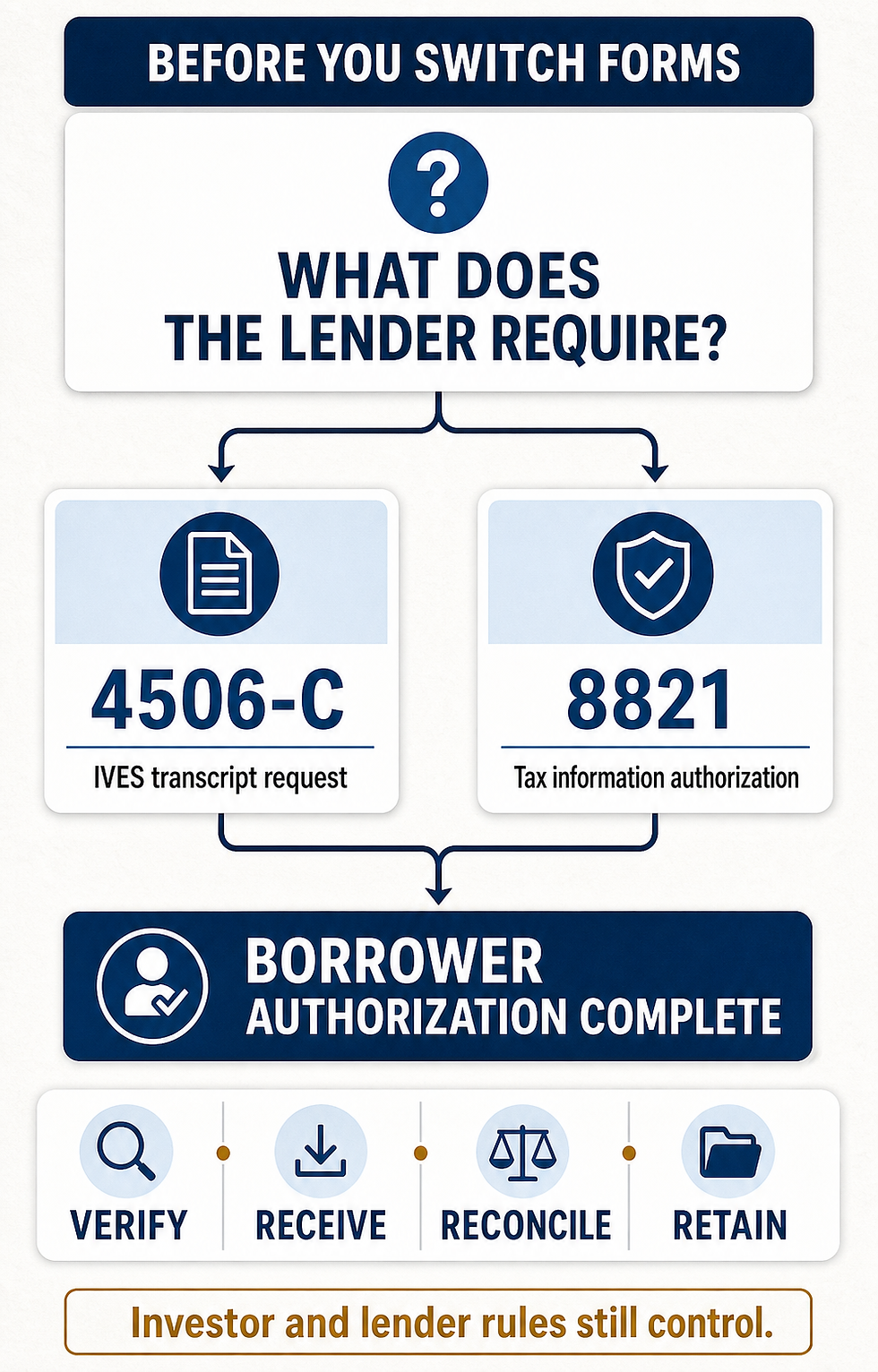
Lender overlays and the actual loan program still control. For a broker team, the lesson is not simply “there’s a new form available.” It is “confirm the authorization path earlier.”
The two forms do different jobs
Form 4506-C is the IVES Request for Transcript of Tax Return. The IRS describes IVES as the program mortgage lenders and other participants use to request tax transcripts with the taxpayer’s authorization.
The details matter. Fannie Mae’s guide notes that separate Forms 4506-C may be needed when a file requires personal and business return transcripts because only one tax form can be requested on each form.
Form 8821 is a Tax Information Authorization. It allows a taxpayer to authorize a named person or organization to inspect or receive specified confidential tax information. IRS instructions say that when Form 8821 is used for a non-tax purpose such as lender income verification, the IRS must receive it within 120 days of the taxpayer’s signature.
That is why simply swapping one form for another is not a process. The authorization must match the lender’s transcript-retrieval method, the information being requested, and the requirements of the loan.
The operational risk is in the handoff
Problems tend to appear when the broker, processor, lender, and borrower each assume someone else defined the request.
Before an authorization goes out, confirm:
The required transcript type, such as a tax return transcript or wage and income transcript
Whether the request is for the borrower personally, a business entity, or both
The exact tax years or periods
The recipient or designee information
The required signatures and dates, including any joint-return or business-signature considerations
Any separate authorization needed to disclose IRS-derived information to Fannie Mae
Who will compare the transcript with the income documents already in the file
The IRS says incomplete or inaccurate information on Form 4506-C can result in rejection. Its Form 8821 instructions also warn that general references such as “all years” or “all taxes” can be returned. Neither document should be treated as a blank signature page.
For another practical look at defining ownership before underwriting, see EPC’s California mortgage-processing workflow guide.
A cleaner transcript workflow
1. Set the loan path before documents go out
Start with the AUS recommendation, investor, lender, and the income documentation being used. If the loan is intended for Fannie Mae, use the current Selling Guide as the baseline, then confirm the lender’s process. Do not project a Fannie Mae clarification onto FHA, VA, non-QM, or another investor’s file.
2. Define the exact request
Identify the tax form, tax periods, transcript type, personal or business entity, and recipient. For a self-employed borrower with both personal and entity returns, confirm whether the lender needs more than one authorization.
3. Complete the form before the borrower signs
The borrower should be able to review a completed request, not guess what will be added later. Fannie Mae specifically notes that a borrower should not be required to sign an IRS authorization before the requested transcript, years or periods, and date have been completed.
4. Reconcile the result and retain the record
If transcripts arrive before closing, Fannie Mae requires the lender to use them to verify the income documentation used in underwriting. A discrepancy needs to be investigated and documented; it should not become an unexplained loose end in the file.
This is a good candidate for a repeatable checklist inside the loan-origination system. EPC recommends ARIVE because it can centralize the handoff, ownership, and milestone tracking, but ARIVE is not required to work with EPC. Brokers who want help can use EPC’s ARIVE setup and training resources to build the checklist into a working process rather than relying on memory.
A clearer explanation for the borrower
The borrower does not need an IRS-form lecture. They need to understand what they are authorizing and why the completed details matter.
We need your permission to request specific IRS information for your mortgage file. The form and tax years depend on the lender and how your income is documented. Please review every completed field before signing. If your name, address, filing status, or business information changed, tell us first.
That explanation is brief, accurate, and gives the borrower a reason to slow down long enough to review the request.
The practical takeaway
Form 8821 creates another potential authorization path in some Fannie Mae files. It does not remove lender-specific procedures or the need to define the request carefully.
The strongest workflow is still straightforward: confirm the loan path, identify the exact tax information needed, use the lender-accepted authorization, obtain informed signatures, reconcile what comes back, and retain the record.
Talk through your processing workflow
Is transcript collection or the income-documentation handoff creating avoidable back-and-forth? Book a processing strategy call with EPC to map who requests, receives, reviews, and stores each item. EPC’s contract mortgage-processing services can work with the system you already use, with assisted ARIVE onboarding available when it is useful.
Sources and further reading
This article is for general educational purposes. Fannie Mae, IRS, lender, investor, and agency requirements can change. Verify the current requirements for every transaction. EPC does not provide tax or legal advice.


Comments